How it works

Two questions, answered from the same wallet: which card to tap right now, and which cards are worth holding over a year.

Switch: location, then category, then the best next dollar

  1. Where you are

    Cardflare resolves your location in a fixed order: an override you have set for that place first, then named chains it recognises, then — on the paid tier — a Google Places lookup. Deny location and you pick the place or category yourself.

  2. Which category that is

    The place becomes one spend category: groceries, dining, gas, transit, travel, streaming, online shopping, drugstores, utilities, rent, entertainment, warehouse clubs, Walmart, Amazon, or everything else.

  3. The best card for the next dollar

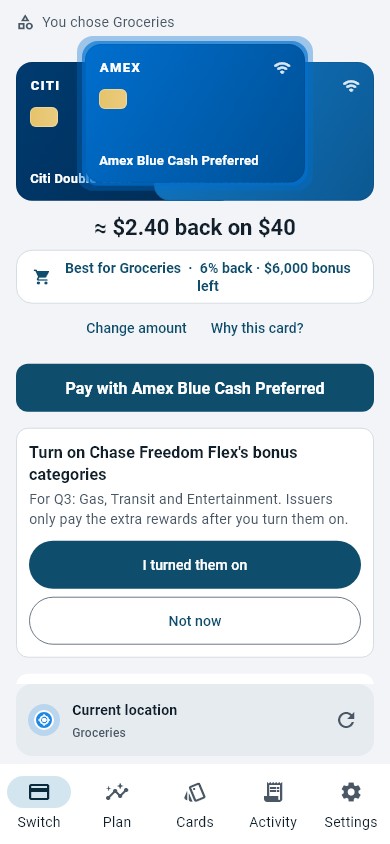
    Among the cards you own, Cardflare picks the one that earns most on thenext dollar in that category — not the best rate on paper, but the rate you would actually get right now. You can pin a different card to a place and it will be shown there from then on.

The Cardflare Switch tab with automatic store detection on, showing the detected store, the category it maps to, and the best card for it.The Cardflare Switch tab with automatic store detection on, showing the detected store, the category it maps to, and the best card for it.
Switch names the place, the category and the reason.

Caps and rotating categories

A headline rate is rarely the whole story, so the next-dollar answer takes both of these into account.

Annual and periodic caps

Many bonus rates stop after a set amount of spend — a year's worth, or a quarter's, or a month's — and the card drops to its base rate after that. Cardflare tracks how much of each cap is left and stops recommending a card once its bonus is used up. The remaining amount is shown with the pick, so you can see why.
Rotating and pick-your-own categories

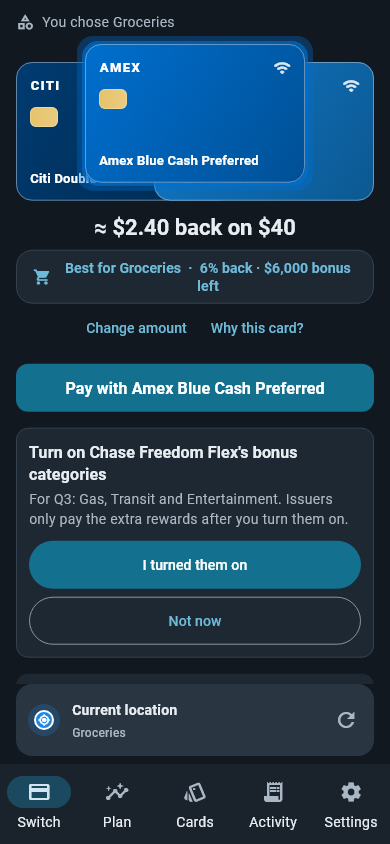
Some cards change their bonus categories every quarter, and some let you choose. Those rates usually only pay after you activate them, so Cardflare uses this quarter's categories, and shows an in-app reminder when a card's categories still need turning on. Quarterly caps are counted the same way as annual ones.

Plan: three levels of savings

Plan takes a credit score, roughly twelve months of spend and the cards you hold, and searches for the best combination of your current wallet plus new cards to apply for, in what order, net of annual fees and signup bonuses. It reports the result at three levels, so you can decide how much of the upside you believe.

1. Cash only

Only rewards that arrive as cash or a statement credit. The most conservative number, and the one that needs nothing from you beyond spending.

2. Cash plus signup bonuses

The same, plus the signup bonuses you would qualify for, counted against the minimum spend and the window each issuer sets.

3. Full upside

Points and travel redemptions as well, if you turn them on. Points you could not realistically use are valued at $0 in the ranking, but they are still noted so you can see what was left out.

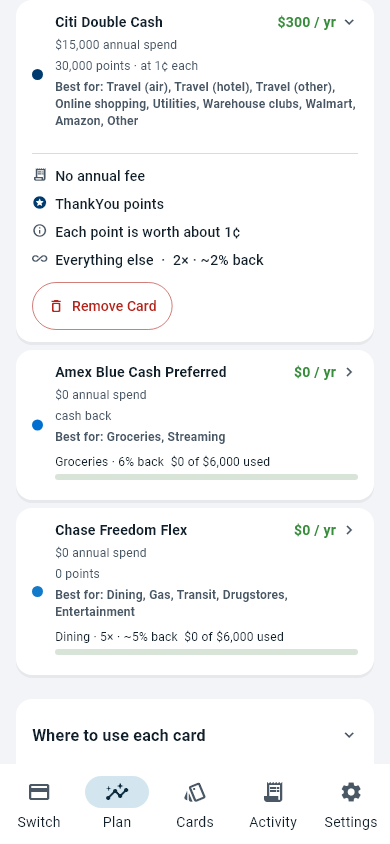
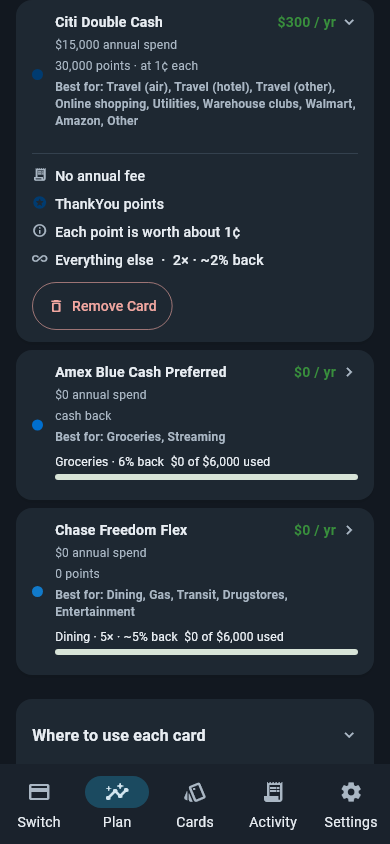
A card expanded in the Cardflare Plan tab, showing yearly value, annual spend, reward currency, what each point is worth, and the categories the card is best for.A card expanded in the Cardflare Plan tab, showing yearly value, annual spend, reward currency, what each point is worth, and the categories the card is best for.
Each card's yearly value, opened up.

What the plan is built on

Free, the plan runs on the purchases you log yourself. On the paid tier it can use a Plaid bank connection instead, so year-to-date spend and bonus caps come from real transactions rather than memory.

Either way the card terms come from Cardflare's own catalog, hand-curated and approximate, with terms as of 2026-09-10. Check with the issuer before you apply.

Browse the card catalog

Cardflare never moves money. It does not intercept, tokenize or route a payment. You still tap the card it shows you.